
How to Search the Lafayette Court Docket
Two local starting points cover most Lafayette docket needs. The official Lafayette City Court Case Search is one stop. It lets you look up City Court matters by Docket # or by name. For the 15th Judicial District Court, the Lafayette Parish Clerk’s online-records page routes covered cases to paid ClerkConnect access. That parish tool spans civil, family, probate, criminal, and traffic categories, though its public landing page shows no Lafayette-specific fields. Keep the eSearch land-record login out of it. That system serves property records, not City Court or 15th JDC cases.
Match your search to the court named on the citation, petition, summons, notice, or prior order. Bring a docket number when you have one. A name search works for City Court too. But check the result for the right status, occurrence date, and court-date event. A blank City Court result proves nothing about the parish file. The matter may sit elsewhere. It could be with the Parish Clerk, another municipal court, a Justice of the Peace, or the Third Circuit on appeal.
- Identify Lafayette City Court, 15th JDC, or another court from the paperwork.
- Use City Court Case Search for a City Court docket number or name route.
- Use the Clerk’s current ClerkConnect instructions for a covered district case.
- Read the result’s court, case number, status, and latest setting before relying on it.
- Call the court clerk when a result is absent, delayed, sealed, or unclear.
Lafayette City Court Docket Portal
Lafayette City Court stands out among area municipal courts. Its case-search interface is free and clearly documented. The Case Search page accepts a docket-number query. Use a format like XX012345678, or search by name. What makes the Lafayette record so useful for orientation is its detail labels: case number, status, date and place of occurrence, violation or amended violation, disposition, mandatory-court status, fine and bond details, sentence details, probation details, and court-date events. No single case is guaranteed to fill every field, though.
Read the court’s legal notice before relying on any result. City Court warns that data can change without notice. It may lag behind filings. It is not a real-time warrant-status source. Updates run about every 30 minutes. Delays still happen. For a same-day setting, a required appearance, or an urgent case status, call City Court. Do not trust a stale screen. The official entry point is Lafayette City Court Case Search, which shows the municipal docket interface itself.
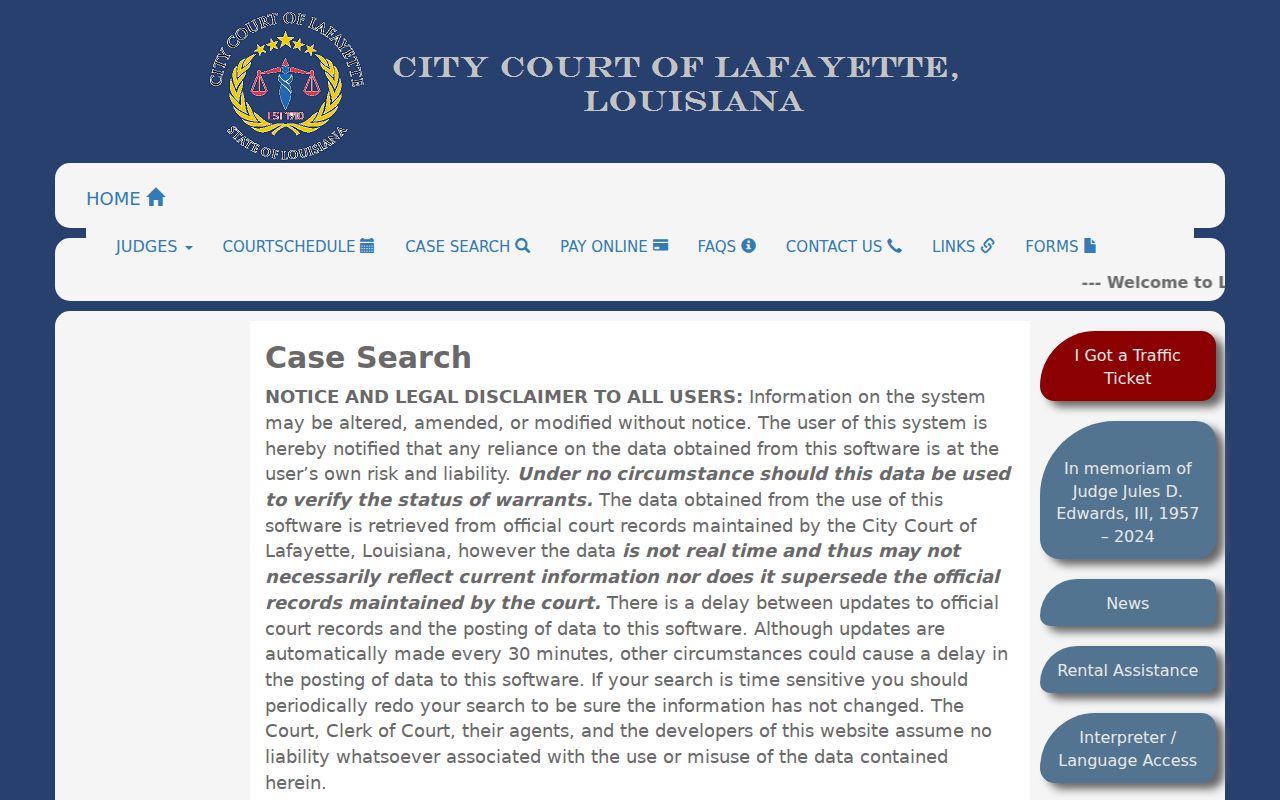
The Lafayette search screen splits a docket-number route from a name route. That split helps when a summons number is already in hand.
The Lafayette Municipal Court
Lafayette City Court is a court of record. It stands on its own, not as a counter of the Parish Clerk’s district court. Its territorial jurisdiction covers corporate Lafayette plus the third and tenth wards of Lafayette Parish. It handles local civil, criminal, juvenile, and traffic matters. Published civil jurisdiction runs generally up to $35,000. Small claims go up to $5,000, with listed exclusions. A Lafayette case outside that territorial or subject-matter scope belongs elsewhere, even when a party lives in the city.
The court dates to 1910. It publishes two city judges, a city marshal, staff, and its public court tools. Find it at 105 E. Convent Street, Lafayette, LA 70501, with a main number of (337) 291-8720. The court’s phone menu separates traffic, criminal and traffic questions, civil, juvenile, and administration. Use that local routing instead of sending a generic request to the 15th JDC clerk for a record City Court itself keeps.
Lafayette City Court
105 E. Convent Street
Lafayette, LA 70501
(337) 291-8720
Use the case type to select the court’s published traffic, criminal, civil, juvenile, or administration route.
Lafayette City Court’s official home page identifies the court’s jurisdiction and public contact path.
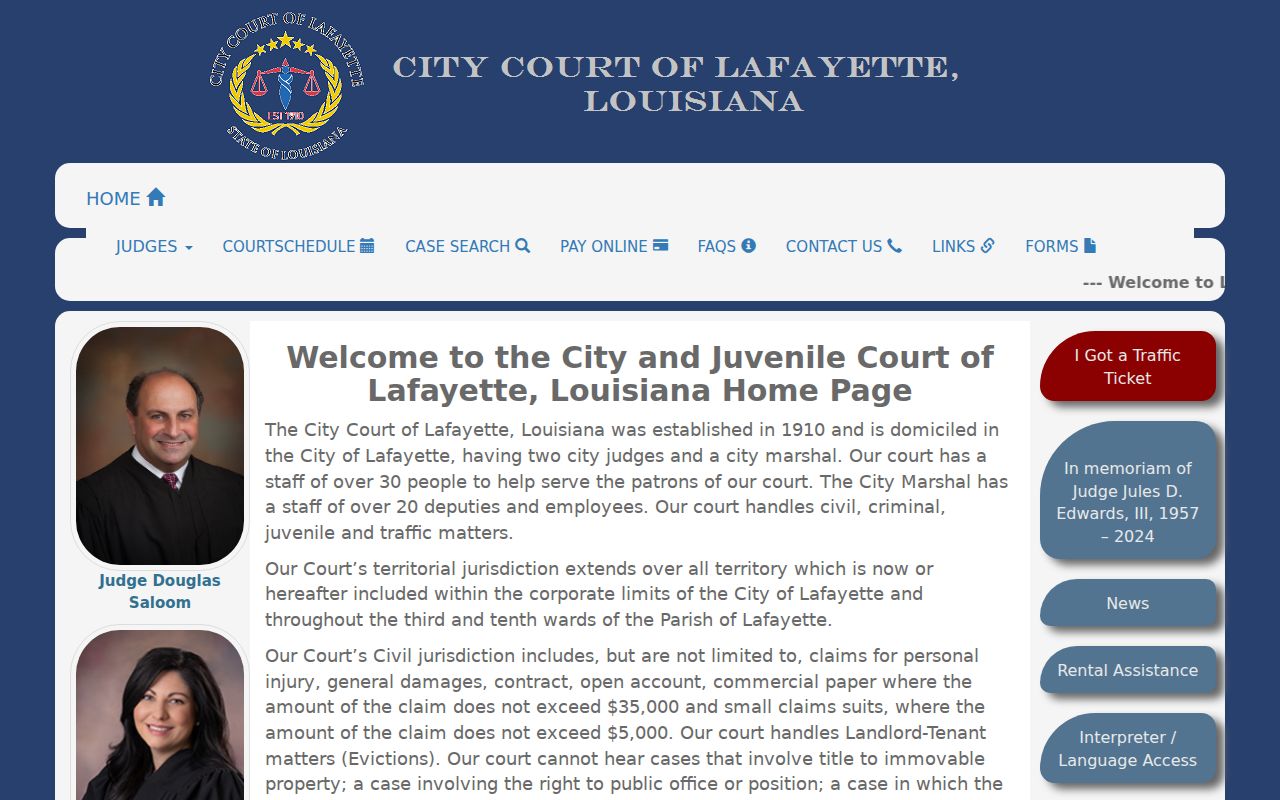
The Lafayette City Court source helps separate municipal court files from the district files the Parish Clerk maintains.
Lafayette Docket Detail Fields
A Lafayette City Court result gives you a record header plus court events. It is not necessarily every filed document. Case details can flag the status, the violation, the disposition, and whether court is mandatory. Fine details may break out an amount imposed apart from an amount paid, or a bond amount. Sentence and probation fields add more docket context. Court-date events carry a warning of their own. One older status entry cannot support an inference about a future setting.
ClerkConnect coverage at the Parish Clerk looks different. The service describes case information, history, service, minutes, disposition, and document or copy routes for covered district files, but its exact public field labels and local case-number grammar sit behind the paid access path. When you request a Lafayette district copy, include a case number, caption, document title, copy count, regular or certified choice, delivery address, and payment instructions, and send it to the appropriate Clerk department.
| Case number | The court-assigned identifier for the Lafayette file. |
|---|---|
| Status | The administrative posture, such as pending or disposed. |
| Mandatory court | A City Court field that should be checked before payment. |
| Court-date events | Chronological settings that require a current-date check. |
| Minute entry | The Clerk’s record of what occurred, separately priced by the Parish Clerk. |
Lafayette Court Dates and Settings
Start with the right court. Match any Lafayette court date to that court and the newest entry in the case. City Court posts a Court Schedule page, though the live schedule fields do not display. Case Search can list court-date events instead. The 15th JDC puts out a master calendar with columns for Lafayette, Acadia, and Vermilion. That calendar is a division scheduling aid, though. It is not a personal case lookup. For your own matter, one thing outranks everything else. A setting in the case history, a notice, or a signed order.
Confused about a City Court event? Call the court when the screen, the notice, and the ticket disagree. For a district event, check the current docket first. Then try the division secretary, clerk, or calendar as needed. Renovation notices, holidays, and revised calendars can all change access. Remember that a reset or passed setting is not a dismissal. Track down the latest entry or get confirmation from the court itself.
| Date | The latest confirmed Lafayette setting, not simply the oldest listed event. |
|---|---|
| Time | Confirm whether it is a docket call, court appearance, or individual setting. |
| Court | City Court and the 15th JDC use separate calendars and custodians. |
| Setting type | It may be an arraignment, rule, motion, trial, or compliance event. |
| Status | Read the current status with the court-date event. |
Lafayette Ticket Date Differences
A Lafayette traffic ticket can show an appearance date that is not the court date. Per City Court's FAQ, the date at the bottom of a ticket is an appearance date. That date is for the Traffic Bureau. The notice of arraignment generally follows 45 to 60 days after issuance. That later notice, the current City Court record, or a confirmed court setting controls. The point matters most once the ticket date has passed. It also matters if a payment screen appears before any court date is clear.
Rescheduling has its own rule. City Court says a person must generally appear before the scheduled date with picture identification. An exception applies if an enrolled attorney handles it. A third party may make a timely payment. That payment cannot substitute for a required arraignment appearance. A payment option is not a calendar update. Call the Traffic Bureau before a required Lafayette appearance slips by.
Lafayette Traffic Tickets
City Court's Pay Online page lets you search by citation number, docket number, or name. Payable categories include common speeding, red-light, failure-to-signal or yield, and most equipment matters. Some categories are non-payable or require an appearance. These include zone-speeding, suspension, license, crash, OWI, past-date, mandatory, and juvenile matters. Read the mandatory-court field on the City Court result before you pay.
Paying an eligible citation counts as a guilty or no-contest resolution. The eligible Lafayette City Court payment also waives formal arraignment, attorney, trial, and appeal rights. Want to contest it? Follow the notice first. Or contact the Traffic Bureau before paying. District traffic files belong in the 15th JDC. They stay with the Parish Clerk. The Lafayette Parish traffic court records reference maps the county-wide split. It covers City Court, the clerk, and municipal traffic routes.
Lafayette Court Payment Choices
Lafayette City Court splits its payment channels and fees. The online card-processing fee is 5% and nonrefundable. At the courthouse, the card-processing fee is 3.5%. Cash, money order, cashier's check, or certified funds are accepted at the courthouse window. By mail, send a money order, cashier's check, or certified funds. Never send cash. Personal or business checks are not accepted by mail. Keep the online confirmation or receipt after the transaction.
Paying is not the same as requesting a docket copy. A receipt may lack the full case history, the minute entry, or a certified document. Unclear mandatory status, a past date, or an appearance requirement on a Lafayette result calls for a phone call to City Court, not a guess. The City Court payment page also carries inconsistent driver-improvement-school timing language, so call the court first if that issue affects you.
Where Lafayette Cases End Up
Lafayette City Court does not hear every Lafayette dispute. Felonies, major civil cases, family or probate matters, and qualifying district traffic cases route to the 15th Judicial District Court and its Lafayette Parish Clerk. That court serves Acadia, Lafayette, and Vermilion Parishes. Read its calendar and jurisdictional record path with care. If a trial-court matter is appealed, the Louisiana Court of Appeal, Third Circuit in Lake Charles holds the appellate docket.
Docket flow: Lafayette City Court › Lafayette Parish courts › 15th Judicial District Court of Louisiana.
A Lafayette district record can be reached through ClerkConnect, the Clerk counter at 800 S. Buchanan Street, phone, email request, mail, or a statutory public-record request where appropriate. The Parish Clerk is not automatically the custodian of a City Court docket, though. For the full parish-level court map, see the Lafayette Parish court docket home page.
Lafayette Criminal Filing Delay
Lafayette City Court cautions that criminal filings can lag an arrest or referral. The lag runs 30 to 60 days. So an early search may come back empty. That gap is a City Court timing quirk, nothing more. It does not tell you a case was filed. And it does not tell you what a missing record means. A blank result in a Lafayette docket search can also mean the case sits in another court. Or access may be limited.
If a Lafayette criminal record fails to appear, call City Court on the criminal line. Ask whether a docket number exists yet. District criminal matters belong with the Parish Clerk's Criminal Records Department, not another round of name searching. Juvenile, sealed, and expunged records follow their own access rules. Never read anything into a public result about a person or how a case ends.
Public Access to Lafayette Court Records
Get Lafayette court records from the court that holds them. Louisiana Code of Civil Procedure Article 251 names the clerk as custodian. Except where law says otherwise, it lets you examine and copy files during office hours. Louisiana's public-records laws back that right to inspect and copy, within confidentiality rules and limits set by each court. Before asking the City Court clerk or the Parish Clerk for anything, pin down the case, the document, the date range, whether you want regular or certified copies, and how you want delivery.
Access still has boundaries. Children's Code Article 412 keeps juvenile records confidential. Code of Criminal Procedure Article 973 does the same for expunged criminal material. Legal exceptions apply. A sealed file may simply never show up. So may a protected identifier or a restricted record. An ordinary Lafayette search can miss all of them. If a public-record request gets denied, ask the custodian what portion can be confirmed. Get the statutory basis in writing.
Lafayette record rules: La. C.C.P. Art. 251 addresses clerk custody and examination or copying of court records. La. R.S. 44:31 states the public inspection and copying right, subject to exceptions. Children’s Code Art. 412 protects juvenile records.
Lafayette Court Schedule Limits
A Lafayette calendar helps, but it is not a case docket. City Court's official schedule page exists, though live entries did not render. The 15th JDC calendar publishes master blocks, a division legend, and parish columns. It offers no interactive Lafayette personal-name query. Always cross-check a date. Use the newest City Court or clerk-held case event, a notice, or a division confirmation.
That guardrail prevents a common Lafayette misread. A general schedule can show a type of docket is planned. The case itself may have been reset, passed, continued, transferred, or restricted. A case-history line can show that something happened. It may not give you the full filed document. Let the calendar explain the setting. Then let the owning court confirm the individual Lafayette case. Lafayette City Court's schedule page is the municipal scheduling source.
Treat the Lafayette schedule as a planning aid only. The court confirms the actual setting for each case.